

Board results can bring a mix of relief, excitement, and sometimes disappointment. If you feel not satisfied with CBSE board marks, you are not alone — thousands of students across India go through this every year. The good news is that CBSE offers clear, official ways to address genuine concerns about your evaluated answer sheet.
At Al-Barkaat Malik Muhammad Islam English School, we believe that students and parents should approach this moment with facts, not panic. This guide explains exactly what to do, step by step, using only official CBSE procedures — without creating false hope or exaggerating what verification or re-evaluation can achieve.
Quick Answer: If you are not satisfied with CBSE board marks, CBSE allows you to apply for a photocopy of your evaluated answer sheet, followed by Verification of Marks and/or Re-evaluation within the notified window. These facilities check for totalling errors or reassess specific answers — they do not guarantee higher marks, since scores can also remain unchanged.
Why Students Feel Not Satisfied With CBSE Board Marks.
It's completely normal to feel disappointed after seeing your result, especially if it doesn't match your expectations based on your own preparation. Common triggers include:
- A gap between self-assessment during the exam and the final score
- Marks that seem lower than what classmates with similar preparation received
- Confusion over how internal assessment or practical marks were added
- A single subject pulling down an otherwise strong overall performance
Our educators at Al-Barkaat encourage students to first pause and process the result calmly before deciding on next steps, because emotional reactions often lead to hasty decisions.
Common Reasons Behind Unexpected Results.
Before assuming something went wrong in evaluation, it helps to understand the usual reasons behind an unexpected score:
- Totalling errors – Occasionally, marks awarded to individual answers are not added up correctly.
- Unattempted or partially attempted questions – Sometimes students
underestimate how much of a question they actually answered.
- Presentation and structure – Answers lacking clear structure, labelled diagrams, or step-wise working may lose marks even if the concept was understood.
- Genuine gaps in understanding – Occasionally, the result may simply reflect the actual level of preparation, which is worth acknowledging honestly.
- Evaluation on the CBSE On-Screen Marking System – Since answer books are scanned and marked digitally, evaluators follow a strict marking scheme, which can feel stricter than expected.
Based on our experience in guiding CBSE students, most concerns fall into the first two categories, which is exactly why CBSE's verification process exists.
Stay Calm Before Taking Any Decision.
This is the most important step, and often the most skipped one.
At Al-Barkaat, we advise parents to remain calm and understand the official CBSE procedures before making decisions, rather than reacting immediately out of frustration or worry. A calm approach helps in three ways:
- It allows students to review the answer sheet objectively rather than emotionally.
- It gives families time to check the actual CBSE notification instead of relying on rumours.
- It prevents unnecessary spending on multiple applications without a clear reason.
Our educators explain that one examination result does not define a student's future, and this perspective genuinely helps reduce the pressure of the post-result period.
Official Options Provided by CBSE.
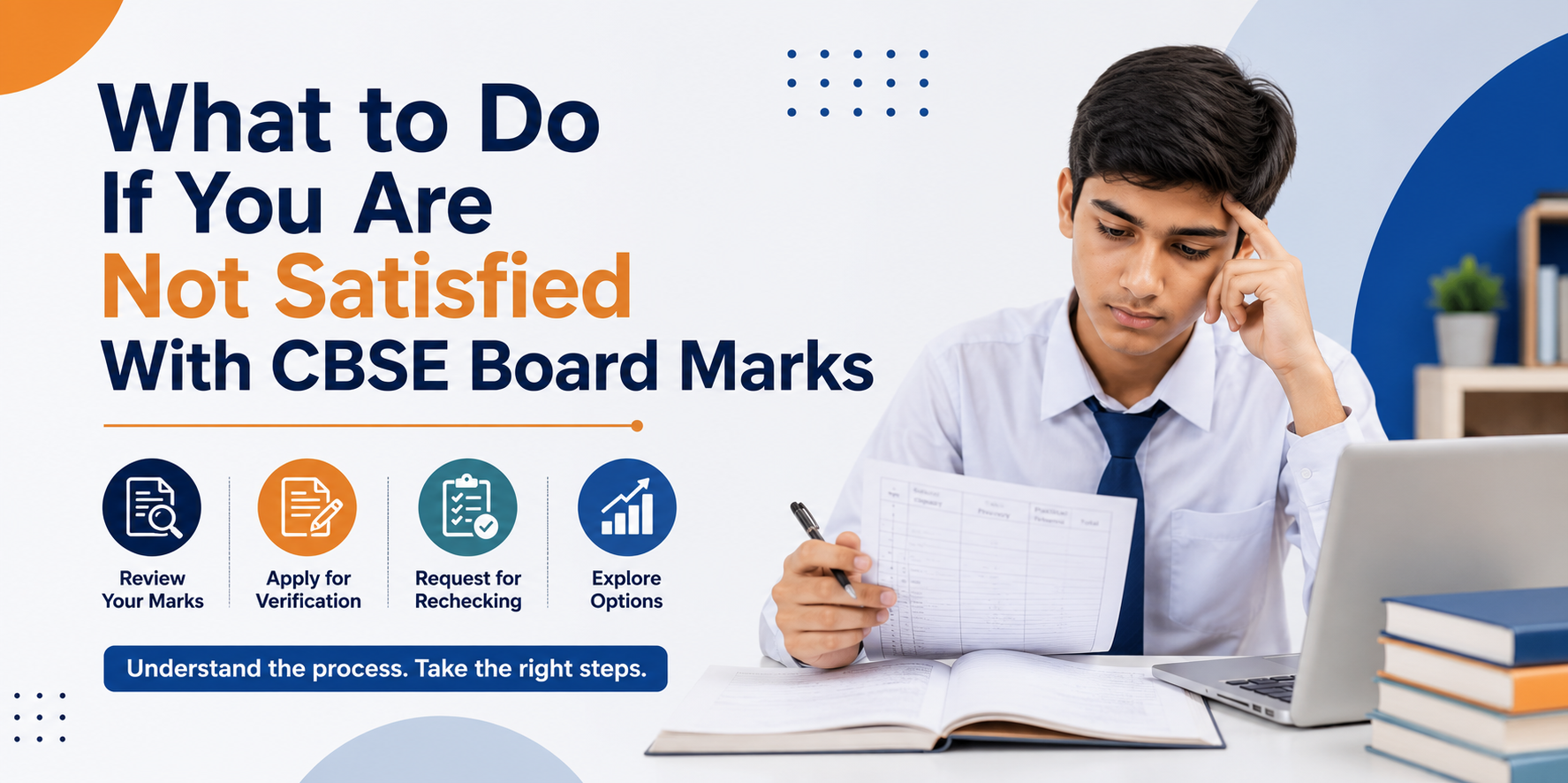
If, after calmly reviewing your result, you still feel not satisfied with CBSE board marks, CBSE provides three official post-result facilities, usually applied for in this order:
- Photocopy of the Evaluated Answer Sheet – To see exactly how your paper was marked.
- Verification of Marks (also called Verification of Issues Observed) – To check totalling and whether all questions were evaluated.
- Re-evaluation – To have specific answers reassessed against the marking scheme.
These options are meant to ensure fairness and accuracy, not to promise a particular outcome. We encourage students to review official CBSE options carefully before applying for verification or re-evaluation, since each serves a different purpose.
Verification of Marks Explained
Verification of Marks checks whether:
- All questions in the answer book were evaluated
- Marks for each question were transcribed and totalled correctly
- There is no clerical mismatch between the answer sheet and the final result
It does not involve reassessing the quality of an answer. If an error is found, the marks are corrected; if none is found, the result is reported as "No-change."
Photocopy of Answer Sheet Explained
Applying for a photocopy allows students to see the scanned, evaluated answer book, including the evaluator's marking and comments on each answer. This step is usually the first and most useful one, because it helps a student decide — with actual evidence — whether verification, re-evaluation, or both are worth applying for.
Our teachers recommend going through this photocopy question by question, rather than only checking the total, since specific comments often explain why marks were awarded the way they were.
Re-evaluation Explained
Re-evaluation involves a fresh assessment of selected answers by another evaluator, based strictly on the CBSE marking scheme. This is different from verification, since it looks at how an answer was assessed, not just how it was totalled. Marks can increase, decrease, or stay the same after re-evaluation, depending on what the fresh assessment finds.
Comparison Table: Verification vs Photocopy vs Re-evaluation.
|
Aspect |
Photocopy of Answer Sheet |
Verification of Marks |
Re-evaluation |
|
Purpose |
View the evaluated answer book |
Check totalling and evaluation completeness |
Reassess specific answers |
|
Changes answer quality assessment? |
No |
No |
Yes |
|
Usually applied |
First, right after result |
After reviewing photocopy |
After reviewing photocopy |
|
Can marks increase? |
Not applicable |
Yes, if error found |
Yes, if reassessment differs |
|
Can marks decrease? |
Not applicable |
Rare, only if a genuine error is found |
Yes, possible in some cases |
|
Outcome if no issue found |
N/A |
"No-change" reported |
Marks confirmed as originally awarded |
How to Decide Which Option Is Right for You.
When you feel not satisfied with CBSE board marks, the decision on which facility to apply for should be based on evidence, not guesswork. Here's a simple approach:
- Start with the photocopy. Always review the actual evaluated answer sheet first.
- Look for totalling or evaluation gaps. If a question appears unmarked or marks don't add up, apply for Verification.
- Look for assessment disagreement. If you believe a fully correct answer was under-marked according to the scheme, consider Re-evaluation.
- Apply within the window. CBSE notifies specific dates each year; applications outside this window are typically not accepted.
- Track your application. Keep your acknowledgment number safe until the outcome is declared, usually through DigiLocker.
At Al-Barkaat, we believe informed decisions help reduce unnecessary stress after board results, and this evidence-based approach is far more reliable than applying for every option "just in case."
Common Mistakes Students Should Avoid.
Even when you are genuinely not satisfied with CBSE board marks, a few common mistakes can make the process harder than it needs to be.
- Applying for verification or re-evaluation without first checking the answer sheet photocopy.
- Believing social media rumours instead of checking the official CBSE website or DigiLocker.
- Assuming that applying guarantees higher marks, when the outcome can also be "no-change."
- Missing the official application window because of relying on unofficial reminders.
- Sharing personal CBSE login credentials with unauthorised agents or coaching centres claiming to "guarantee" results.
- Comparing marks with friends or classmates instead of focusing on one's own paper and progress.
Practical Advice for Parents
Parents play a significant role in how a student handles this period. A few practical suggestions:
- Listen first, advise later — let your child express disappointment before jumping to solutions.
- Help them access the official CBSE photocopy and read it together calmly.
- Avoid comparing your child's marks with siblings, cousins, or neighbours' children.
- Encourage a factual, step-by-step approach rather than an emotional one.
- Remind them that one result, whether from a school in Mumbai, Maharashtra, or anywhere else in India, is only one part of a much longer academic journey.
Our academic team encourages students to focus on continuous learning rather than comparing marks with others, and parents play a big role in reinforcing that mindset at home.
Mental Well-being After Board Results
Board results can affect a student's confidence, especially if the outcome feels unfair or unexpected. It's important to remember:
- Feeling disappointed is a normal, human reaction — not a sign of weakness.
- One subject or one exam does not determine long-term ability or potential.
- Talking to teachers, mentors, or school counsellors can help process the result constructively.
- Taking a short break before deciding on verification or re-evaluation often leads to clearer thinking.
According to the academic guidance shared by Al-Barkaat, students who talk openly with parents or teachers about their result tend to make more balanced decisions than those who withdraw or panic silently.
Expert Tips from Educators.
- Always start with the official answer sheet photocopy before applying for anything else.
- Apply within the notified CBSE window — late applications are generally not accepted.
- Keep expectations realistic: verification and re-evaluation correct genuine errors, they don't reward extra effort or "deserving" marks.
- Use only cbse.gov.in, results.cbse.nic.in, or DigiLocker for updates — avoid third-party promises of guaranteed results.
- If you remain not satisfied with CBSE board marks even after verification, focus on the next academic milestone, such as Class 11 stream selection or future board exams, rather than repeatedly revisiting the same result.
Our teachers recommend treating this process as a fact-finding exercise, not an emotional appeal, since CBSE's evaluation system is designed around a fixed marking scheme.
Official CBSE Guidelines.
CBSE has confirmed, through its official communication for the 2026 examination cycle, that Class 12 candidates could apply for a photocopy of their evaluated answer books after result declaration, followed by a window to apply for Verification of Issues Observed and/or Re-evaluation. Outcomes were then released in a phased manner through DigiLocker, with marks corrected wherever a genuine discrepancy was confirmed.
CBSE has also publicly urged students and parents not to rely on rumours or unverified social media posts regarding post-result processes, stating that authentic updates are shared only through its own official channels. Specific Class 10 verification timelines, fees, and any further 2026 updates that have not yet been announced should be checked directly on the official CBSE website, since we encourage students to review official CBSE options carefully rather than assume dates or rules that CBSE has not yet confirmed.
Conclusion
Feeling disappointed with a board result is understandable, but reacting with clear information rather than panic makes all the difference. If you are still not satisfied with CBSE board marks after reviewing your answer sheet, CBSE's Verification and Re-evaluation facilities offer a fair, transparent way to check for genuine errors — while being honest that outcomes can go either way.
At Al-Barkaat Malik Muhammad Islam English School, we believe every result, however it turns out, is simply one step in a much longer learning journey. We encourage students and parents to rely on official CBSE sources for every decision, and to remember that consistent effort over time matters far more than a single set of marks.
If you would like to learn more about quality CBSE education or admissions, feel free to contact Al-Barkaat School. Our team is always happy to guide parents and students with the right information.
Frequently Asked Questions (FAQs)
- What should I do if I am not satisfied with my CBSE board marks?
First, apply for a photocopy of your evaluated answer sheet to understand exactly how it was marked. Based on what you find, you can then apply for Verification of Marks, Re-evaluation, or both, within the window notified by CBSE on its official website.
- Can CBSE marks increase after verification?
Yes, marks can increase if verification finds a genuine totalling error or an unevaluated question. However, marks can also remain unchanged if no discrepancy is found, so an increase is not guaranteed in every case.
- Should I apply for verification or re-evaluation?
This depends on what you notice in your answer sheet photocopy. If totals seem incorrect or a question looks unmarked, apply for Verification. If you believe a fully correct answer was under-marked, Re-evaluation may be more appropriate.
- What is the difference between verification and re-evaluation?
Verification checks totalling and whether every question was evaluated, without reassessing answer quality. Re-evaluation involves a fresh assessment of specific answers against the marking scheme by another evaluator, and can change marks based on that fresh review.
- Can marks decrease after re-evaluation?
Yes, it is possible for marks to decrease, increase, or remain the same after re-evaluation, since it involves a fresh, independent assessment. Students should apply only when they have genuine reason to believe an answer was under-assessed.
- Is answer sheet photocopy necessary before applying for verification?
While not always compulsory, reviewing the photocopy is strongly recommended, since it shows the actual marking and evaluator comments. This helps students make an informed decision instead of applying for verification or re-evaluation without clear evidence.
- How long does the CBSE verification process take?
The timeline varies each year depending on the number of applications. In recent cycles, CBSE has released outcomes in a phased manner over a few weeks after the application window closed, through DigiLocker.
- Can Class 10 students apply for verification or re-evaluation?
Yes, CBSE generally extends these facilities to Class 10 students as well, following a similar process to Class 12. However, students should confirm exact dates and fees for their specific year from the official CBSE notification.
- Can Class 12 students apply for verification or re-evaluation?
Yes, Class 12 students can apply for photocopy, verification, and re-evaluation within CBSE's notified windows after result declaration. Outcomes are shared through DigiLocker once the evaluation process for each application is completed.
- Where can I apply for CBSE result verification?
Applications are submitted only through the official CBSE post-result services portal on cbse.gov.in. Students should avoid third-party websites or agents claiming to process verification applications, since this facility is handled exclusively by CBSE.