

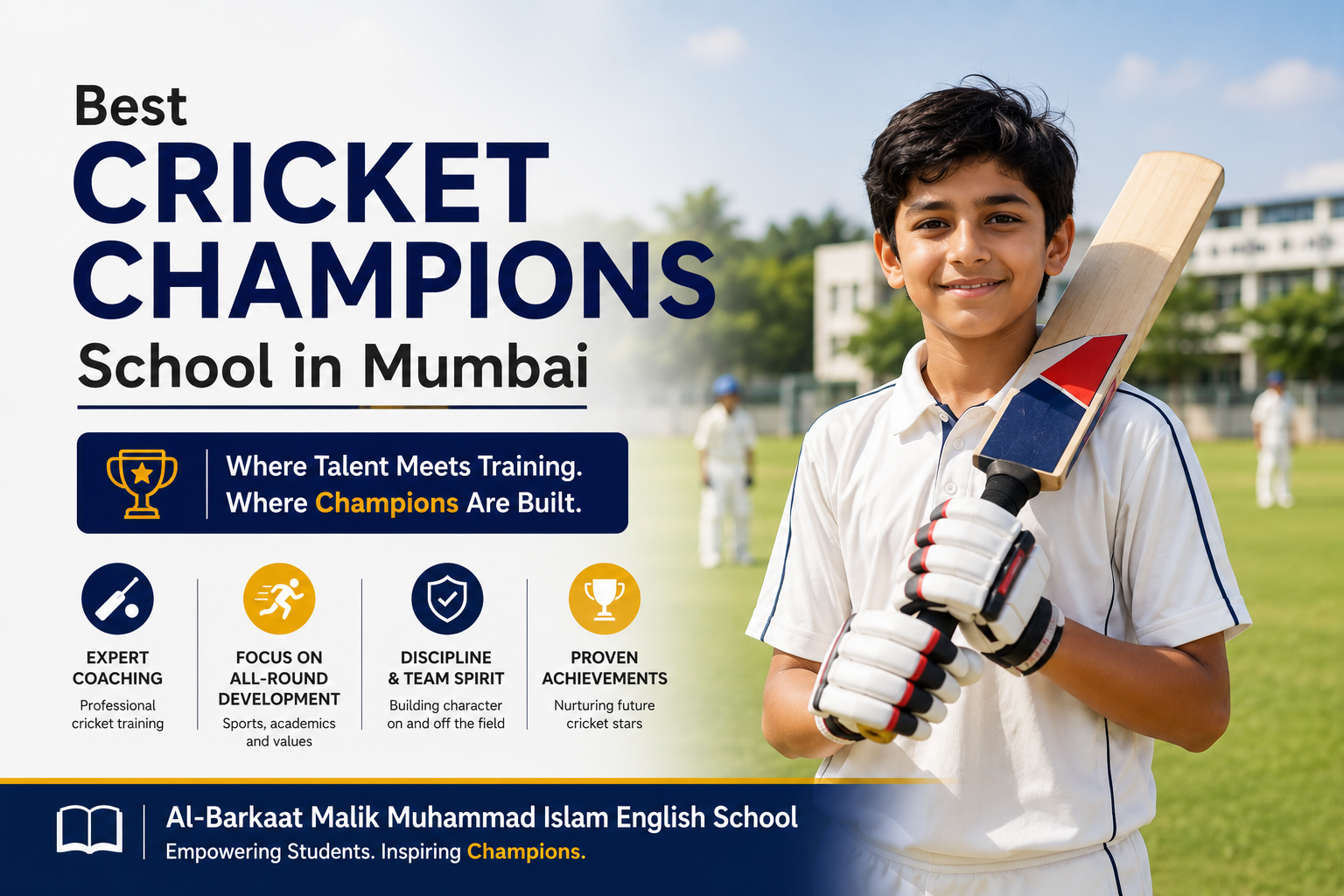
It usually starts the same way. A child picks up a bat in the building compound or a weekend camp, shows real promise, and suddenly the parent is asking a very different question than the usual "which school has the best results?" They're asking whether any school nearby can actually take that talent seriously.
That question is exactly why Cricket Champions School has become a real search term among Mumbai parents — not as a marketing phrase, but as a filter for shortlisting schools that won't make a child choose between the sport they love and the grades they need.
Why Parents Are Looking for a Cricket Champions School.
Cricket coaching outside school hours is expensive, time-consuming, and often disconnected from a child's academic calendar. Parents juggling both end up exhausted, and children end up stretched between two routines that were never designed to work together.
A school built around cricket changes that equation. Training happens on the same daily clock as classes, which removes the logistics problem entirely — that's the real appeal, not just better coaching, but one less thing for families to coordinate.
Features of a Cricket Champions School.
Marketing brochures use this label loosely, so it helps to know what genuinely qualifies:
-
A cricket ground or nets on campus, not borrowed from elsewhere
-
Coaches with formal certification, not just former players volunteering
-
Age-banded training groups instead of one-size-fits-all sessions
-
A fixture calendar with actual inter-school matches
-
Equipment and protective gear maintained by the school
If a school can't speak specifically to most of these, the label is doing more work than the program behind it.
Cricket Training by Age and Stage.
Good programs don't train every child the same way. Here's roughly how serious school cricket programs structure development:
|
Age Group |
Training Focus |
Typical Weekly Hours |
|
6–9 years |
Basic motor skills, hand-eye coordination |
2–3 hours |
|
10–12 years |
Technique, fielding drills, rules of the game |
3–5 hours |
|
13–15 years |
Match strategy, fitness conditioning |
5–7 hours |
|
16+ years |
Competitive play, leadership roles |
7–10 hours |
This kind of structured progression is what separates cricket training for students from informal weekend practice — it builds skill in layers instead of throwing every child into the same drill.
What Cricket Actually Teaches a Child.
Ask any coach and they'll say cricket's real value has little to do with the scoreboard.
-
Patience — a long innings teaches children to wait for the right moment instead of forcing one
-
Accountability — every dropped catch happens in full view of teammates
-
Strategic thinking — field placements and bowling changes require constant problem-solving
-
Resilience — a bad over rarely ends the match, just like a bad test isn't the end of a term
These aren't soft claims. Coaches who work with school-age cricketers consistently report that children who learn to stay composed at the crease tend to handle exam pressure differently too.
Can Cricket and Studies Actually Coexist?
This is the question every parent eventually asks, and the honest answer is: it depends on scheduling, not willpower.
Schools that get this right run training before the academic day starts or right after it ends, never overlapping with core teaching hours. During exam periods, serious programs scale back match commitments rather than cancel training outright, so students don't lose conditioning right before tournaments resume.
The cricket and academics balance that works isn't about cutting back on cricket when studies get serious — it's about building a timetable where neither one has to wait for the other.
What a Strong Sports Setup Looks Like Beyond the Ground.
A playground alone doesn't make a sports-focused school. Look for these sup.€porting elements too:
-
Indoor fitness or conditioning space for monsoon months
-
A physiotherapist or first-aid trained staff member during practice
-
Storage and maintenance for shared equipment
-
A clear policy on managing injuries and return-to-play timing
Schools that have thought through these details usually have a more mature sports culture overall, not just a good cricket team.
Before You Shortlist: A Parent's Field Test.
Don't take coaching claims at face value. Before deciding, visit during an actual practice session, not a scheduled demo. Watch whether the coach corrects technique individually or just runs general drills. Ask how many matches the team played last season, and against which schools. Find out what happens to a student-athlete's coursework when a tournament clashes with exams. Finally, talk to a parent whose child has gone through a full season, not just the admission counsellor.
About Al-Barkaat Malik Muhammad Islam English School.
In Kurla, Al-Barkaat Malik Muhammad Islam English School runs its cricket program alongside the regular academic timetable rather than as a separate after-hours activity. Students get structured coaching built into the school day, keeping both cricket and classroom commitments on the same calendar instead of competing for a child's evenings.
This kind of integration is worth noting for any parent comparing English medium schools in Mumbai where sports is meant to be part of the curriculum, not an add-on.
The Bottom Line for Parents.
A genuine Cricket Champions School isn't defined by trophies on a shelf. It's defined by whether a child can train seriously, study seriously, and not burn out doing both. Before you admit your child anywhere on the strength of its sports reputation, check the coaching credentials, the weekly schedule, and how the school handles exam season — because that's where most programs either prove themselves or fall apart.
Interested in a school that supports both academics and sports? Contact us today to learn more about admissions and student development programs.
Follow Al-Barkaat School on Instagram for regular updates, achievements, and campus highlights.
Frequently Asked Questions.
-
What makes a school a genuine Cricket Champions School?
On-campus cricket facilities, certified coaches, age-appropriate training groups, and real inter-school match participation. If a school can't demonstrate these specifics during a visit, the title is likely more branding than substance.
-
Will cricket training affect my child's grades?
Not if the schedule is built correctly. Schools that run training around academic hours, not into them, and ease up during exams, typically see no negative academic impact — and many parents report improved focus instead.
-
At what age should a child start school-level cricket coaching?
Most structured programs start basic coordination training around age six, with technical skill-building beginning around ten. Starting early helps build fundamentals, but serious specialisation usually isn't necessary before the early teens.
-
How many hours a week should young cricketers train?
It varies by age. Younger children typically train two to three hours weekly, while teenagers in competitive programs may train five to ten hours, depending on fitness levels and tournament schedules.
-
Does playing cricket help with leadership skills?
Yes. Captaincy roles, in-match decisions, and team accountability give students real leadership practice that's hard to replicate in a classroom. Many coaches see this translate into better group work and confidence at school.
-
What should I ask the coach before enrolling my child?
Ask about their certification, how they individualise feedback within group sessions, the team's match history, and how training adjusts during exams. Their answers usually reveal more than any prospectus.