

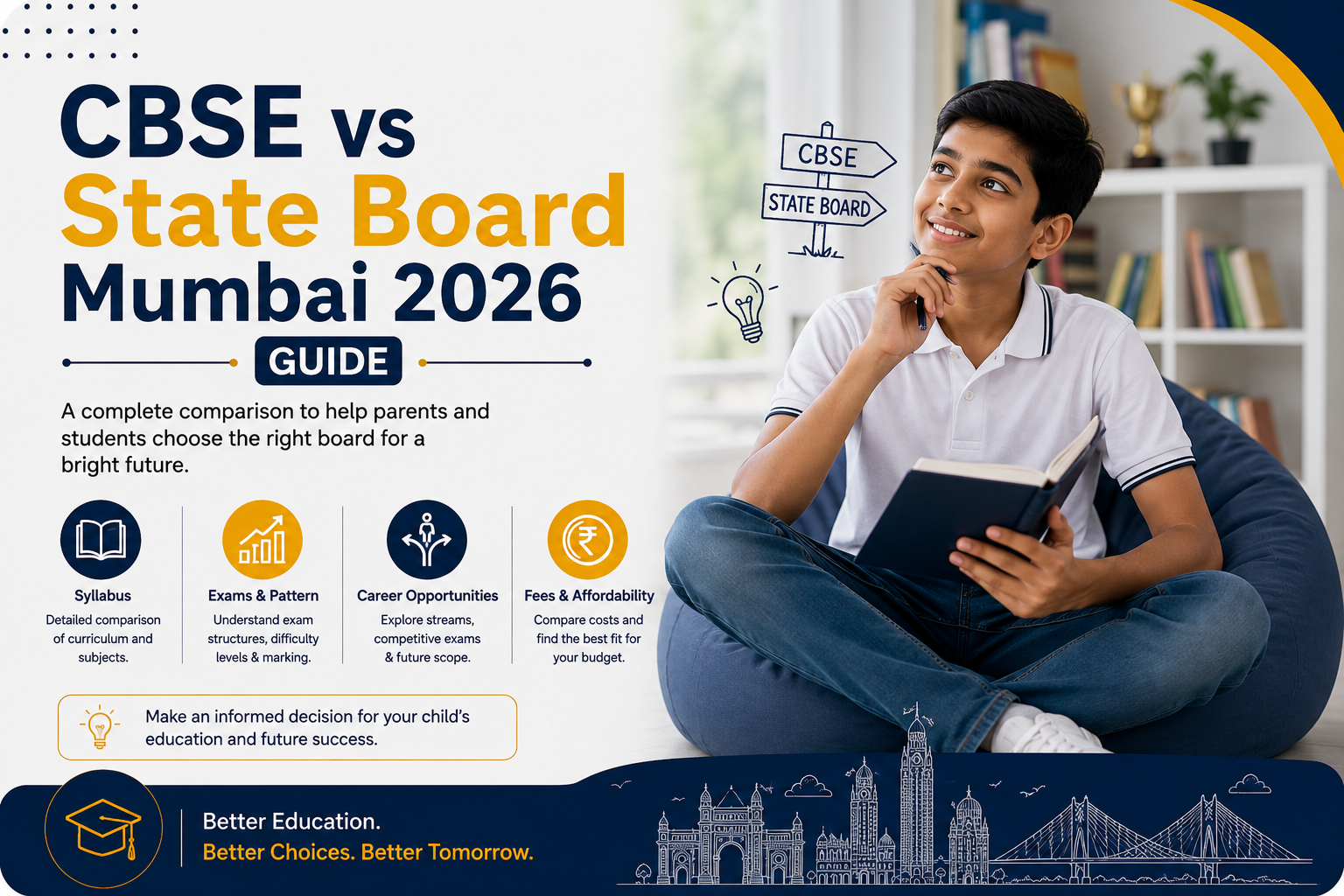
Choosing between CBSE vs State Board is a big decision for Mumbai parents. Both boards have strengths and challenges, and the right choice depends on your child’s needs. CBSE’s national syllabus is concept-driven and well-aligned with competitive exams, while the Maharashtra State Board (MSBSHSE) offers more localized content in Marathi or English. Weighing CBSE vs State Board means considering academics, stress levels, and future goals. For example, EducationAdda notes that “CBSE offers consistency and national recognition, whereas a state board provides localized learning and may be easier in terms of pressure”. Understanding these differences can help parents support their child’s success and address common school challenges for students like exam anxiety and low confidence.
CBSE vs State Board: Curriculum and Exams
One clear difference in the CBSE vs State Board debate is syllabus content and exam style. CBSE follows the national NCERT syllabus, focusing on concepts in Math, Science, Social Studies and Languages. This concept-driven approach helps students prepare for exams like JEE and NEET. By contrast, the State Board includes more regional history, literature and local content. Generally, the State Board syllabus may cover fewer chapters and be slightly easier at the higher secondary level, though this varies by state. In practical terms:
- Medium of Instruction: Most CBSE schools use English (and/or Hindi). State board schools often teach in Marathi (in Maharashtra), making early learning in the mother tongue easier.
- Exam Focus: CBSE’s board exams are uniform across India, so CBSE students learn from the same textbooks nationwide. State board exams are set by Maharashtra’s education department and often emphasize state-specific knowledge. This means students in CBSE vs State Board may face different academic pressure. A CBSE student tackling national-level content might experience more stress preparing for competitive exams, while a State Board student might find the syllabus less intense but may need extra coaching for national tests.
CBSE vs State Board: Difficulty and Rigor
A common parent question is how difficult each board is. In the CBSE vs State Board comparison:
- Rigor: CBSE is often seen as more challenging because of its standardized depth and breadth. It regularly updates curriculum to match national standards. State Board syllabi can vary; sometimes they are less exhaustive, especially at Class 11–12. That can make it easier for students with average academic levels, reducing student stress in school.
- Assessment: CBSE has begun focusing more on internal assessments and has a competency-based exam pattern (like CBSE’s 2026 updates with practical and MCQ components). Maharashtra State Board exams follow a traditional format with 80% theory and 20% practical/Project work. Both have their own marking systems, but CBSE’s system is the same nationwide while State Board standards align with state norms.
- Mobility: CBSE’s uniformity helps students transfer schools within India more smoothly. If a Mumbai family might move to another state or abroad, CBSE can reduce adjustment stress. In Maharashtra, however, CBSE vs State Board doesn’t usually involve transfer between states, but it does matter if the family plans competitive exams or relocation.
CBSE vs State Board: Future Goals and Stress
For parents in Mumbai, thinking about the long-term is key when weighing CBSE vs State Board. If your child aims for national-level engineering or medical entrance exams, CBSE’s syllabus (aligned with NEET/JEE) may give an edge. State Board students often need extra coaching for these exams. However, if your child thrives on learning in their regional language or plans to stay in Maharashtra, the State Board can be a good choice.
Both boards have pros and cons:
- Academic Pressure: Many find CBSE’s curriculum rigorous, which can be academic pressure students. But CBSE also encourages conceptual clarity which can build confidence. State Board might be easier in rote learning, reducing immediate exam stress but potentially leaving gaps for competitive exam prep.
- Student Mental Health: A balanced approach is important. Some parents report that CBSE’s uniform exams, along with recent policy changes (like dual exam attempts and 50% competency questions), can either alleviate or increase stress depending on the child. State Board’s familiarity and local context can reduce cultural stress. Understanding your child’s learning style can help manage student mental health school by choosing the less stressful option.
CBSE vs State Board: Practical Considerations
When comparing CBSE vs State Board, consider practical factors in Mumbai:
- School Fees and Availability: CBSE schools in Mumbai may have higher fees. State Board schools (run by the state or private) can sometimes be more affordable. Many top schools in Mumbai (including some ICSE schools) follow CBSE for perceived national benefit.
- Entrance Exams: Some Mumbai exams (e.g., for junior colleges or state colleges) are based on HSC or SSC results. A State Board curriculum might cover more of the syllabus of these state exams. CBSE students might need to adjust.
- Language Skills: CBSE’s emphasis on English can strengthen language ability for higher education globally. The State Board’s regional medium can strengthen Marathi/Hindi. Choose based on your language preference.
- Consistency vs Flexibility: State boards can modify curriculum locally (recently, some have started using NCERT books too), so content may lag or differ. CBSE is consistently updated. Check CBSE’s official website for curriculum changes to plan ahead.
Parents exploring quality education options can also read our guide on Best CBSE Schools in Mumbai to find the right school.
Conclusion: Balancing Pros and Cons
The CBSE vs State Board choice depends on your child’s needs and your family’s goals. Mumbai parents should weigh academic rigor versus comfort: CBSE provides a nationally-aligned, concept-focused education that may be tougher but uniform, while the State Board offers localized, often easier syllabus. To help with problems students face in school, involve your child in the decision. For example, discuss whether they prefer studying in English or Marathi, and if they aim for national exams. Both boards are recognized for college admissions, but CBSE might give an edge in competitive tests. Ultimately, you know your child best—ensure they have support (tutoring, counseling, balanced schedule) to handle stress and build confidence, especially during the admission enquiry and school selection process.
Contact us today to get expert guidance on choosing the right board and securing the best future for your child.
FAQs (2026)
- Is CBSE really better than the State Board?
Not inherently; it depends on your child’s goals and learning style. CBSE has a national syllabus and aligns with entrance exams, while the State Board offers local content in Marathi/English. Consider which fits your child.
- Which board is easier for students?
Generally, the State Board syllabus is seen as less intense than CBSE’s, which can reduce exam stress. However, state board students may need extra coaching for national-level exams. Choose based on your child’s comfort with stress and learning.
- How does the board affect Mumbai college admissions?
Both CBSE and Maharashtra Board qualifications are accepted for college. State Board students may align better with state entrance tests, while CBSE students might find it easier to apply nationwide. It doesn’t limit options.
- Can students switch from State Board to CBSE (or vice versa)?
Yes, but syllabus differences can be challenging. CBSE’s uniform curriculum may ease transfers. If switching in Mumbai, be prepared to cover missing topics. Plan transitions during breaks.
- How do CBSE and State Board impact child’s confidence?
If a child struggles with conceptual topics, CBSE’s approach could be tough initially. State Board’s familiarity might boost confidence early on. Support your child’s student mental health by providing tutoring or counseling as needed, regardless of board.