

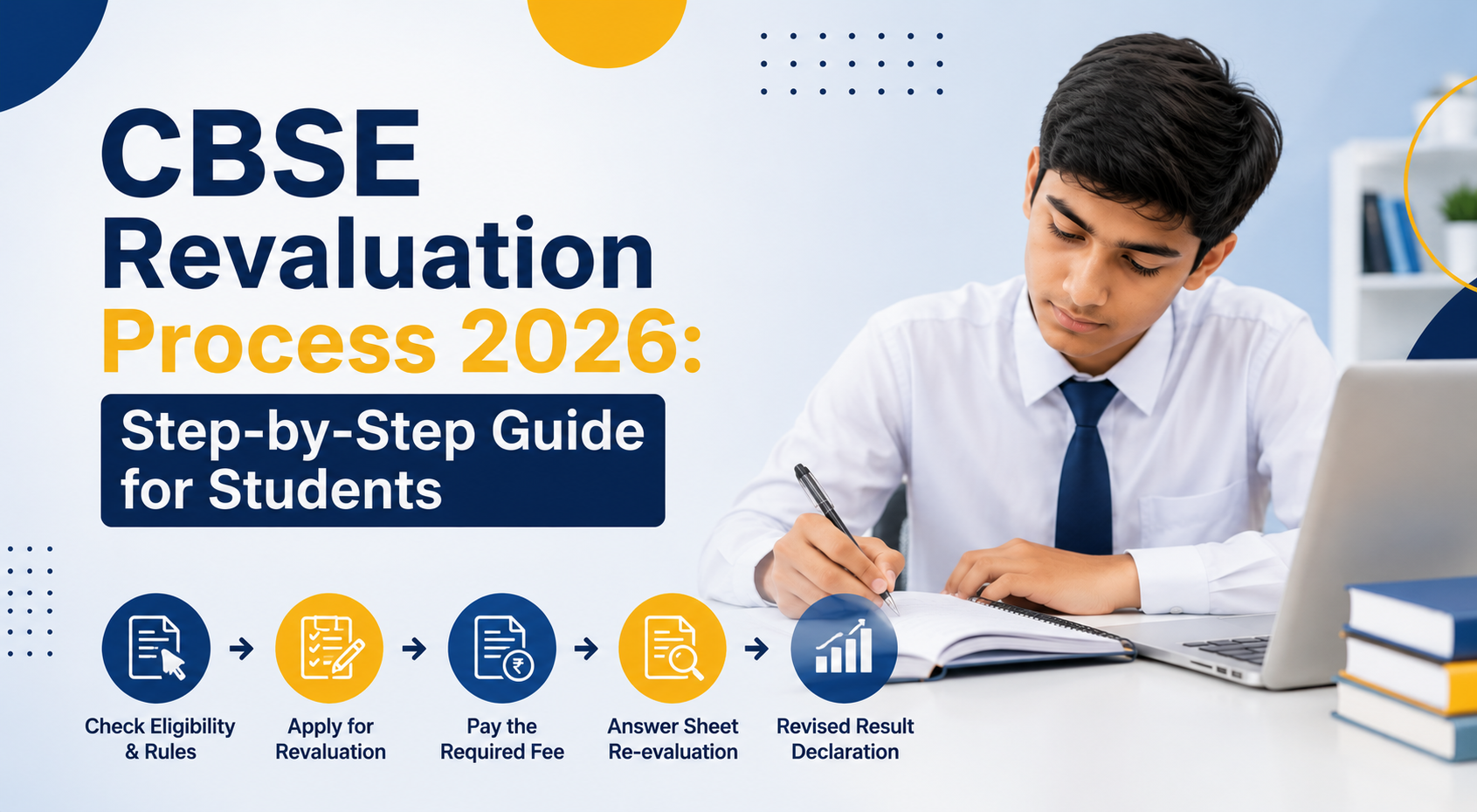
After CBSE Board results are declared, many students wonder whether their marks truly reflect their effort. This is exactly where the CBSE Revaluation Process 2026 becomes important — it gives students an official, transparent way to have specific answers reassessed if they genuinely believe an evaluation error has occurred.
At Al-Barkaat Malik Muhammad Islam English School, we believe that students and parents should understand this process clearly, using only verified CBSE information, before deciding whether to apply. This guide walks through the entire revaluation journey step by step, based strictly on official CBSE procedures.
Quick Definition: The CBSE Revaluation Process 2026 allows students to request a fresh assessment of specific answers in their evaluated answer book, carried out by another examiner strictly as per the CBSE marking scheme. It is applied for after reviewing the answer sheet photocopy, and marks can increase, decrease, or remain unchanged based on the outcome.
What is CBSE Revaluation?
Revaluation, officially referred to by CBSE as "Re-evaluation," is a post-result facility where a specific answer or set of answers is reassessed by a different evaluator. Unlike verification, which only checks totalling and whether every question was marked, revaluation actually re-examines how well an answer matches the prescribed marking scheme.
Our educators at Al-Barkaat encourage students to understand this distinction clearly, since applying for revaluation without a genuine reason often leads to disappointment if the outcome shows no change.
Why Understanding the CBSE Revaluation Process 2026 Matters
Every year, thousands of students search for details on this topic because:
- They want to know whether their answer was assessed fairly against the marking scheme.
- They are unsure of the exact eligibility, steps, or documents needed.
- They want to understand how revaluation differs from verification and photocopy requests.
- They want realistic expectations about whether marks can go up, down, or stay the same.
Based on our experience in guiding CBSE students, most confusion happens when students apply for revaluation without first checking their answer sheet photocopy carefully.
Who Can Apply for Revaluation?
Generally, any student who has appeared for CBSE Class 10 or Class 12 Board Examinations and has received their provisional result can apply for revaluation, provided they apply within the window notified by CBSE. This typically applies to:
- Regular school candidates
- Private candidates, subject to conditions mentioned in the official notification
- Compartment candidates, where applicable, as per CBSE's specific rules for that category
Students studying in CBSE-affiliated schools across India — whether in Mumbai, elsewhere in Maharashtra, or in any other state — follow the same nationwide procedure, since CBSE does not have separate regional rules for revaluation. The eligibility conditions remain identical regardless of the school's location, which makes it easier for students and parents to rely on a single, consistent set of official guidelines.
Eligibility Criteria
While CBSE finalises exact eligibility conditions through its official notification each year, the general requirements for the CBSE Revaluation Process 2026 are expected to include:
- The student must have a valid CBSE roll number and admit card for the relevant examination.
- The student must apply within the notified application window, generally after reviewing the answer sheet photocopy.
- The application must be submitted through the official CBSE post-result services portal, with the applicable fee paid online.
Our teachers recommend confirming these conditions directly on cbse.gov.in each year, since minor procedural changes are common.
Step-by-Step CBSE Revaluation Process 2026
Here is the general sequence CBSE typically follows for revaluation, based on its established post-result procedure:
- Check Your Result – Access your provisional CBSE result through the official website or DigiLocker.
- Apply for Answer Sheet Photocopy – Request a scanned copy of your evaluated answer book within the notified window.
- Review the Photocopy Carefully – Go through each answer, the marks awarded, and the evaluator's comments question by question.
- Decide Whether Revaluation Is Justified – Identify specific answers you believe were not assessed correctly against the marking scheme.
- Apply for Revaluation Online – Submit your application through the official CBSE portal within the notified window, along with the prescribed fee.
- Track Your Application – Keep your acknowledgment number safe to check the status of your request.
- Receive the Outcome – The revised outcome, if any, is typically released through DigiLocker once processing is complete.
At Al-Barkaat, we advise parents to carefully understand the official CBSE revaluation process before submitting any application, since each step depends on the previous one, especially the answer sheet review.
Typical Timeline Pattern (Based on Recent CBSE Cycles)
While CBSE notifies exact dates separately each year, recent examination cycles have generally followed a consistent sequence: results are declared first, followed by a short window for answer sheet photocopies, then a window to apply for verification and/or revaluation, and finally, outcomes released in phases through DigiLocker over the following weeks. This pattern gives students a rough sense of what to expect, though the exact 2026 dates for Class 10 revaluation are still awaited from CBSE's official notification and should not be assumed in advance.
Documents Required
Students should keep the following details ready before starting their application:
- Roll number, school number, and centre number
- Admit card details
- Date of birth as registered with CBSE
- Login credentials for the CBSE post-result services portal or DigiLocker
- Application/reference number from the answer sheet photocopy request, if applicable
Exact document requirements can be updated by CBSE, so students should always cross-check the current list from the official notification before applying.
Important Official Guidelines
- Apply only through the official CBSE website; never use third-party agents or unofficial portals.
- Complete your application strictly within the window notified by CBSE for that academic year.
- Base your revaluation request on specific answers, not a general feeling of dissatisfaction with the overall result.
- Understand that CBSE's decision after revaluation is considered final for that application.
- Preserve your application receipt and reference number until the outcome is declared.
Our educators explain that students should review official guidelines before requesting revaluation, since following the correct procedure genuinely improves the chances of a smooth application experience.
Difference Between Verification, Answer Sheet Photocopy & Revaluation.
|
Aspect |
Answer Sheet Photocopy |
Verification of Marks |
Revaluation (Re-evaluation) |
|
Purpose |
View the evaluated answer book |
Check totalling and evaluation completeness |
Reassess specific answers against the marking scheme |
|
Involves re-checking answer quality? |
No |
No |
Yes |
|
Usually applied |
First, right after result declaration |
After reviewing the photocopy |
After reviewing the photocopy |
|
Can marks increase? |
Not applicable |
Yes, if a totalling or evaluation error is found |
Yes, if the fresh assessment differs |
|
Can marks decrease? |
Not applicable |
Rare, only if an error is confirmed |
Yes, possible in some cases |
|
Outcome if no issue found |
Not applicable |
"No-change" reported |
Original marks confirmed |
What Happens After Revaluation?
Once a student applies for revaluation, CBSE assigns the specific answers for reassessment by another evaluator. The revised outcome, along with any change in marks, is typically communicated through DigiLocker. If the revaluation confirms the original marks, the result is simply reported as unchanged, and no further revaluation request for the same answer is generally entertained.
We encourage students to rely only on official CBSE notifications instead of social media rumours while waiting for their outcome, since unofficial sources often share incorrect timelines or unverified claims about result changes.
Can Marks Increase or Decrease?
This is one of the most searched questions about the CBSE Revaluation Process 2026, and the honest answer is: it depends on the outcome of the fresh assessment.
- Marks can increase if the second evaluator finds that the original assessment missed valid points as per the marking scheme.
- Marks can decrease if the fresh assessment finds that marks were originally awarded beyond what the marking scheme allows.
- Marks can remain unchanged if the original evaluation is confirmed to be accurate.
At Al-Barkaat, we believe informed decisions reduce unnecessary stress after board results, and understanding that revaluation can go either way is an essential part of making that informed decision.
Common Mistakes Students Should Avoid.
- Applying for revaluation without first reviewing the answer sheet photocopy.
- Requesting revaluation for an entire subject instead of specific answers with a genuine concern.
- Missing the official application deadline due to reliance on unofficial reminders.
- Assuming revaluation guarantees higher marks, when outcomes can also be unchanged or lower.
- Sharing personal CBSE login details with unauthorised individuals or coaching centres.
- Ignoring official guidelines and depending on assumptions from previous years instead of the current notification.
Expert Tips for Students and Parents.
- Our teachers recommend reading every evaluator comment on the photocopy carefully before shortlisting answers for revaluation.
- Apply as early as possible within the notified window to avoid last-minute technical issues on the portal.
- Discuss your answer sheet with a subject teacher, who can help identify whether a genuine assessment gap exists.
- Keep expectations realistic — revaluation is about accuracy and fairness, not a guaranteed score boost.
- Our academic team encourages students to focus on learning while following the correct CBSE procedures, rather than spending excessive time worrying about a single subject's outcome.
This balanced approach applies equally to students preparing in Mumbai, across Maharashtra, or anywhere else in India, since CBSE's revaluation procedure remains the same nationwide.
Latest Official CBSE Updates.
For the 2026 examination cycle, CBSE has confirmed that Class 12 candidates were given the facility to obtain answer sheet photocopies after result declaration, followed by a notified window to apply for Verification of Issues Observed and/or Re-evaluation. Outcomes have been released in a phased manner through DigiLocker, with CBSE confirming that the post-result services platform was monitored by technical experts from Digital India Corporation, IIT Kanpur, and IIT Madras to maintain accuracy and integrity.
CBSE has also appealed to students and parents not to rely on rumours or unverified social media posts regarding post-result services. At the time of writing, specific timelines, fees, and further details of the CBSE Revaluation Process 2026 for Class 10 candidates have not been separately confirmed, and students should check the official CBSE website for the latest updates rather than relying on assumptions.
Conclusion
The CBSE Revaluation Process 2026 gives students a fair, official route to have specific answers reassessed when they have genuine reason to believe an evaluation error occurred. It is not a guarantee of higher marks, but a transparent mechanism built around accuracy and fairness.
At Al-Barkaat Malik Muhammad Islam English School, we believe that understanding this process clearly — through official CBSE sources rather than rumours — helps students and parents make confident, informed decisions after board results. We encourage every student to follow the correct steps outlined above and to always confirm details directly from cbse.gov.in.
If you would like to learn more about quality CBSE education or admissions, feel free to contact Al-Barkaat School. Our team is always happy to guide parents and students with the right information.
Frequently Asked Questions (FAQs)
- What is the CBSE Revaluation Process 2026?
It is CBSE's official facility that allows students to request a fresh assessment of specific answers in their evaluated answer book. It is applied for after reviewing the answer sheet photocopy, and marks can increase, decrease, or remain unchanged after the reassessment.
- Who can apply for CBSE revaluation?
Class 10 and Class 12 students who have received their provisional CBSE result can generally apply, provided they do so within the window notified by CBSE. Exact eligibility conditions for private and compartment candidates should be confirmed from the official notification.
- How do I apply for CBSE revaluation online?
Students apply through the official CBSE post-result services portal on cbse.gov.in, after logging in with their roll number, admit card details, and other required information. The application must be submitted within the notified window, along with the applicable fee.
- What is the difference between verification and revaluation?
Verification checks totalling and whether all questions were evaluated, without reassessing answer quality. Revaluation involves a fresh assessment of specific answers by another evaluator, based strictly on the marking scheme, and can change marks accordingly.
- Is answer sheet photocopy required before revaluation?
While not always compulsory, reviewing the photocopy is strongly recommended before applying for revaluation. It shows the evaluator's actual marking and comments, helping students identify specific answers that genuinely deserve reassessment.
- Can marks increase after CBSE revaluation?
Yes, marks can increase if the fresh assessment finds that valid points were missed in the original evaluation. However, this is not guaranteed, since the outcome depends entirely on what the second evaluator finds.
- Can marks decrease after CBSE revaluation?
Yes, it is possible for marks to decrease if the revaluation finds that marks were originally awarded beyond what the marking scheme permits. This is why students should apply for revaluation only when they have a genuine, specific concern.