

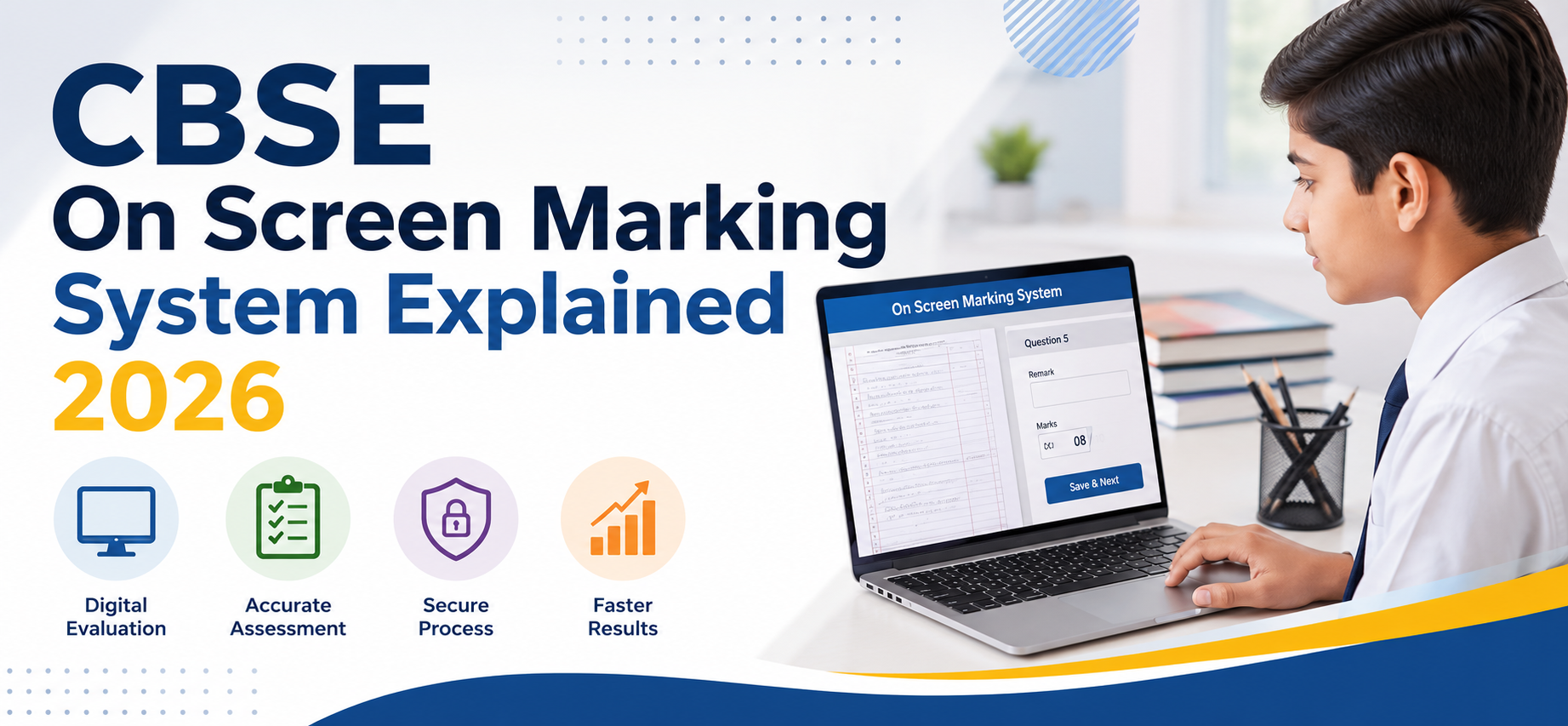
Every year, once board exams are over, students and parents start wondering the same thing: how exactly does CBSE check thousands and thousands of answer sheets, and how can anyone be sure it's done fairly? This curiosity has grown even more since CBSE introduced digital evaluation for board exams — a shift that naturally raises questions about accuracy, security, and whether technology can really replace a teacher's careful reading of an answer.
At Al-Barkaat Malik Muhammad Islam English School, we believe that understanding how evaluation actually works helps remove unnecessary anxiety after exams. This article explains the CBSE On Screen Marking System in plain, simple language — what it is, how it functions, and what it means for students in Mumbai, Maharashtra, and across India.
What is the CBSE On Screen Marking System?
The CBSE On Screen Marking System is a digital evaluation method where scanned copies of answer sheets are checked by examiners on a computer screen instead of on paper. Answers are scanned securely, uploaded to a monitored portal, and marked question-wise using the same marking scheme used in traditional evaluation — just through a digital interface. official CBSE website
Why CBSE introduced digital evaluation
With lakhs of students appearing for board exams every year, manually checking, transporting, and totalling physical answer sheets became an increasingly complex task. CBSE introduced digital evaluation to make the process faster, more organised, and less dependent on manual handling at every stage.
Objectives of the On Screen Marking System
The system was designed with a few clear goals in mind: reducing totalling and transcription errors, improving transparency in how answers are checked, speeding up the overall evaluation timeline, and maintaining strict confidentiality of student identity during marking. Our educators at Al-Barkaat encourage students to see this as a step toward a more consistent and error-resistant evaluation process, rather than something to be nervous about.
How Does the CBSE On Screen Marking System Work?
Digital evaluation follows a structured, multi-stage process. Here's how it typically unfolds, step by step.
Step 1: Collection of Answer Sheets
After the exam, physical answer books are collected from exam centres and sent to designated CBSE regional locations for further processing.
Step 2: Scanning Process
Each answer sheet is carefully scanned using specialised book scanners, without altering, cutting, or de-threading the original booklet, so that every response is captured exactly as written.
Step 3: Secure Digital Upload
Once scanned, the digital images are uploaded to a secure, monitored evaluation portal. Student roll numbers and identity markers are masked before this stage, which helps keep the evaluation anonymous and unbiased.
Step 4: Allocation to Examiners
Scanned answer sheets are assigned to trained, authorised examiners through a centralised system. Examiners only see the answers, never the student's identity, which supports fair and impartial checking.
Step 5: Digital Evaluation
Examiners log in to the secure portal and evaluate each answer on screen, question by question, using the official marking scheme provided for that subject. Marks are awarded digitally, in the same structured manner as traditional checking.
Step 6: Quality Checks
Scanned images go through quality checks at multiple stages — once during scanning, and again after upload. If any page is unclear or improperly scanned, it is flagged and rescanned before being sent for evaluation.
Step 7: Final Result Preparation
Once evaluation is complete, marks are compiled digitally, which reduces manual totalling errors, and results are prepared and released through CBSE's official channels.
Benefits of the CBSE On Screen Marking System
- Reduces common totalling and transcription errors that can occur during manual checking
- Removes the need to physically transport answer sheets across locations, saving time
- Keeps student identity hidden from examiners, supporting unbiased evaluation
- Allows structured quality checks at multiple stages of the process
- Creates a digital record of evaluation, which can make future verification more efficient
- Enables trained examiners to evaluate from their own institutions in a monitored environment
Based on our experience in guiding CBSE students, we've found that understanding these safeguards genuinely helps reduce the anxiety that often surrounds result time.
Manual Evaluation vs Digital Evaluation
|
Feature |
Manual Evaluation |
Digital (On Screen) Evaluation |
|
Format of checking |
Physical answer booklet |
Scanned digital image on screen |
|
Marks totalling |
Done manually, so errors can occur |
Auto-tabulated, reducing totalling errors |
|
Transport of answer sheets |
Physical movement between centres |
No physical transport required |
|
Anonymity of student |
Depends on manual masking |
Roll numbers digitally masked before evaluation |
|
Quality monitoring |
Limited, mostly post-evaluation |
Multi-stage quality checks during and after scanning |
|
Evaluation location |
Central evaluation camps |
Examiners can evaluate from their own institution |
Common Myths About CBSE On Screen Marking
|
Myth |
Fact |
|
A computer or AI decides the marks |
Trained human examiners evaluate every answer; the system only assists with scanning, display, and totalling |
|
Digital evaluation is less careful than manual checking |
The same official marking scheme is used, with added multi-stage quality checks on scanned images |
|
Only Class 10 or only certain subjects use this system |
On-screen marking has been introduced for specific classes as per official CBSE notifications, and coverage can expand over time |
|
Scanned answer sheets can be tampered with |
Answer books are scanned without altering the original content, and access is restricted to authorised, monitored logins |
|
Students can access the marking portal |
The evaluation portal is meant only for authorised examiners and school-related users, not for students |
At Al-Barkaat, we advise parents to rely on facts rather than assumptions when it comes to something as important as board result evaluation.
How Students Benefit from Digital Evaluation
For students, the biggest practical benefit is a more standardised and monitored checking process. Since scanned copies are preserved digitally, students who later apply for a photocopy of their answer sheet or for verification often find the process smoother, since the digital record is already available. Our teachers explain that this connectivity between evaluation, photocopy, and verification services is one of the quieter but meaningful advantages of moving to a digital system.
Does the On Screen Marking System Reduce Errors?
Yes, in several specific ways. Digital evaluation removes manual totalling mistakes by automatically aggregating question-wise marks. It also ensures that no answer is accidentally skipped, since the system is structured to require evaluation of every scanned page. That said, no evaluation system — digital or manual — can claim to be entirely free of human judgment differences, which is exactly why CBSE continues to offer post-result services like verification and re-evaluation for students who have specific, genuine concerns.
Expert Tips for Students After Board Exams
- Focus on your preparation and revision rather than speculating about how your paper will be checked.
- If your result doesn't match your expectations, review the process calmly — start with an answer sheet photocopy before considering further steps.
- Avoid comparing your marks informally with classmates without first understanding the actual marking scheme.
- Keep your admit card and result details safely, since these are needed for any future post-result application.
- Speak with your subject teacher if you have a specific concern about how an answer was evaluated.
The academic team at Al-Barkaat recommends that students treat board evaluation as a structured, rule-based process — not something driven by chance or guesswork.
Common Mistakes Students Should Avoid
- Believing rumours or unofficial social media posts about how marking works
- Assuming digital evaluation means marks are decided by a computer rather than a trained examiner
- Panicking about a lower-than-expected result before checking official post-result options like photocopy or verification
- Ignoring official CBSE notifications and instead relying on assumptions from previous years
- Not keeping exam and result-related documents organised for future reference
Official CBSE Guidelines Students Should Know
CBSE issues detailed official notifications and FAQs explaining how its evaluation system works, including which classes and subjects are covered in a given academic year. At Al-Barkaat, we encourage students to rely only on official CBSE notifications for the latest, accurate information, since evaluation policies, covered classes, and procedures can be updated or expanded from one year to the next. We believe understanding the CBSE evaluation process helps reduce unnecessary stress, and our educators guide students to focus on learning rather than worrying about rumours.
How Al-Barkaat Malik Muhammad Islam English School Supports Students
At Al-Barkaat Malik Muhammad Islam English School, we believe that academic confidence comes from understanding, not assumption. Our educators guide students through every stage of the board exam journey — from preparation to result day and beyond — including helping them understand official CBSE services like the CBSE Board Result Rechecking Process 2026 Guide and how to apply for a CBSE Answer Sheet Photocopy Online 2026. According to the academic guidance shared by Al-Barkaat, students who understand how their papers are evaluated tend to approach results with far more clarity and far less stress.
Conclusion
The CBSE On Screen Marking System represents a structured shift toward digital evaluation, built around reducing manual errors, protecting student anonymity, and adding multiple layers of quality checks. It does not replace the human judgment of trained examiners — it simply changes the medium through which that judgment is applied. For students and parents, the most important takeaway is to rely on official CBSE notifications for accurate, current details, and to approach evaluation with understanding rather than worry.
If you would like to learn more about quality CBSE education or admissions, feel free to Contact Us.
Frequently Asked Questions
- What is the CBSE On Screen Marking System?
It is a digital evaluation method where scanned copies of student answer sheets are checked by trained examiners on a computer screen instead of on paper. The same official marking scheme is used, with the process supported by multi-stage quality checks and secure digital handling.
- How does CBSE check answer sheets under this system?
Answer sheets are scanned after exams, uploaded to a secure monitored portal with student identity masked, and then assigned to authorised examiners who evaluate each answer digitally using the prescribed marking scheme for that subject.
- Is CBSE paper checking done digitally for all classes?
Digital evaluation coverage depends on official CBSE notifications for a given academic year, and it may apply to specific classes or subjects rather than all of them at once. Students should always confirm current coverage through official CBSE sources.
- Is the On Screen Marking System accurate?
The system is designed to reduce totalling and transcription errors through automated tabulation and multi-stage quality checks on scanned images. Evaluation of the actual answers, however, continues to be done by trained human examiners, just as before.
- Does CBSE still use manual checking?
Yes, manual evaluation continues for classes and subjects not yet covered under the digital system, based on official CBSE notifications for that academic year. Both methods rely on the same official marking scheme.
- How are examiners selected for digital evaluation?
Examiners are trained CBSE-affiliated teachers who are given secure login access to the evaluation portal based on official records. They undergo training and mock evaluation sessions before checking actual answer sheets.
- Can students request answer sheet photocopies?
Yes, students can apply for a scanned photocopy of their own evaluated answer sheet through CBSE's official post-result services portal, which lets them review exactly how their answers were marked.
- Is the on-screen marking system used for Class 10?
Coverage for Class 10 depends on the official CBSE notification for that academic year, since digital evaluation has been introduced in phases for specific classes. Always check the latest circular for accurate, current details.
- Is it used for Class 12?
CBSE has introduced digital evaluation for Class 12 board exam answer sheets as part of its phased rollout, as confirmed through official notifications. Students should refer to the current year's circular for exact subject-wise coverage.
- Does digital evaluation reduce mistakes?
Yes, it specifically reduces totalling and transcription errors through automated tabulation. It also ensures every scanned answer is accounted for during evaluation, though examiner judgment on individual answers remains a human process.