

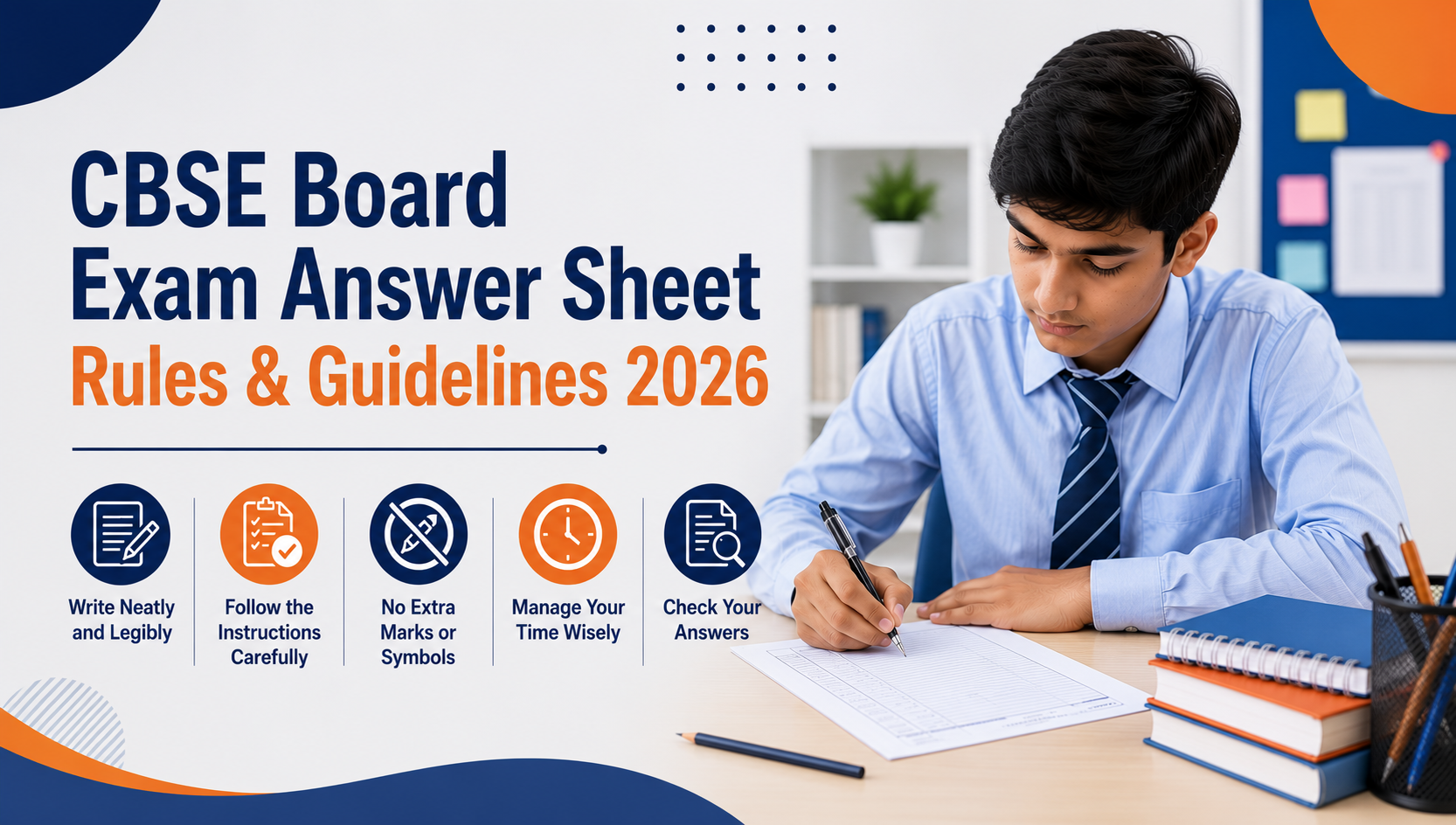
Some CBSE students lose marks not because they didn't know the answer, but because of how they wrote it. Understanding the CBSE Answer Sheet Rules — filling details correctly, numbering answers, using additional sheets, and presenting diagrams properly — can help you avoid these avoidable mistakes in the 2026 board exams.
In short: CBSE requires students to write only in blue or black ink, fill the cover page accurately, write question numbers clearly, follow subject-specific instructions printed on the question paper, and avoid unauthorised markings. The sections below explain these CBSE board exam answer sheet guidelines in detail.
Important CBSE Answer Sheet Rules Students Should Know.
- Fill the cover page carefully — roll number, subject code, and other required fields, as instructed on the booklet.
- Follow printed instructions on the answer sheet and question paper; these can vary by subject.
- Write only in the designated answer space, not in evaluator margins.
- Use only blue or black (royal blue) ink pens — a standard CBSE requirement.
- Number answers correctly, matching the question paper.
- Follow subject-specific instructions. For 2026, CBSE has directed Class 10 Science and Social Science answer sheets be attempted section-wise, and answers in the wrong section may not be evaluated — always check your question paper.
- Use only permitted stationery; correction fluid/whitener is not allowed.
- Avoid unnecessary markings unrelated to your answers.
- Follow invigilator instructions throughout the exam.
How Should Students Write Answers?
- Write the correct question number before each answer.
- Start new answers on a fresh line, with reasonable spacing.
- Use headings or bullet points for long answers where appropriate — general good practice, not a scoring rule.
- In numerical subjects, show your working, not just the final answer.
- Draw diagrams neatly in pencil where required, and label them.
- Keep handwriting legible, and follow the specific formatting instructions on that year's question paper.
Can Students Use Additional Sheets?
Yes. Based on standard CBSE examination practice:
- Additional (supplementary) sheets are provided on request during the exam.
- Each sheet must carry your roll number and required identification details.
- Continue answer and question numbering clearly on the additional sheet.
- Sheets must be tied/attached to the main booklet in sequence, as directed by the invigilator.
- Exact procedures should be confirmed at the exam centre, since they're set by the invigilator on the day.
What Should Students Avoid Writing?
- Irrelevant information or appeals to the examiner.
- Prohibited symbols or unauthorised material inside the booklet.
- Anything unrelated to your subject or exam.
- Incorrect or missing question numbers.
- Unclear corrections — cross out mistakes with a single clean line, not correction fluid.
- Tearing pages, which is treated seriously under CBSE's unfair means (UFM) provisions.
Not every stray mark leads to automatic cancellation, but unclear presentation or ignored instructions can affect evaluation, so following the guidelines carefully matters.
Rules for Diagrams, Maps and Graphs.
- Diagrams should be neat, proportionate, and pencil-drawn unless stated otherwise.
- Label all parts clearly wherever expected.
- Mark the correct question number next to each diagram, map, or graph.
- Requirements can differ by subject (e.g., Biology diagrams vs. Maths graphs), so follow your specific question paper.
Common CBSE Answer Sheet Mistakes to Avoid.
- Incorrect or missing question numbering
- Missing cover-page details
- Not following question-paper-specific instructions
- Poorly labelled diagrams
- Writing in the wrong section where section-wise answering is required
- Using unauthorised stationery
- Spending too long on one question
- Skipping a final review before submission
Quick Checklist
- Before writing: Read instructions carefully · Fill cover-page details correctly · Check subject-specific instructions.
- While writing: Number answers correctly · Keep answers organised · Follow section-wise/subject rules.
- Before submitting: Recheck question numbers · Confirm details are complete · Review unanswered questions if time allows · Follow the invigilator's final instructions.
Al-Barkaat Malik Muhammad Islam English School.
At Al-Barkaat Malik Muhammad Islam English School, we encourage students to understand and follow CBSE answer sheet instructions carefully before and during board examinations. Our teachers guide students on correct question numbering, proper use of stationery, clear presentation, diagrams, additional sheets, and subject-specific instructions. Following these guidelines helps students avoid common mistakes and present their answers clearly and confidently during the examination.
For more information about CBSE education, admissions, and student guidance, contact Al-Barkaat Malik Muhammad Islam English School.
Follow Al-Barkaat Malik Muhammad Islam English School on Instagram for the latest school updates, activities, events, and announcements.
Have questions about admissions or the school? Fill out the Enquiry Form to share your details and receive further information from the school team.
Conclusion
Following the correct CBSE Answer Sheet Rules doesn't guarantee higher marks on its own, but it helps ensure your answers are evaluated accurately and without confusion. Since some instructions vary by subject or year, always cross-check the guidelines printed on your question paper and confirm any doubts with your school before your board exam.
Frequently Asked Questions.
1. What are the CBSE Answer Sheet Rules for 2026? They include using blue/black ink, filling cover-page details correctly, numbering questions clearly, following subject-specific instructions (such as section-wise answering), and avoiding unauthorised markings or materials.
2. How should students write answers in the CBSE answer sheet? Write the correct question number, keep answers organised with clear spacing, show working in numerical subjects, label diagrams properly, and maintain legible handwriting.
3. Can students use additional sheets in CBSE board exams? Yes. They're provided on request during the exam, must carry your roll number, and must be tied to the main booklet in sequence, per the invigilator's instructions.
4. Can students draw diagrams in the CBSE answer sheet? Yes, wherever required. Diagrams should be neat, correctly labelled, and marked with the relevant question number, following your subject's specific instructions.
5. What mistakes should students avoid in the CBSE answer sheet? Avoid wrong question numbering, unclear corrections, writing in the wrong section, unauthorised stationery, and submitting without a final review.
6. What stationery is allowed in CBSE board exams? Generally, blue or black ink pens for writing and a pencil for diagrams. Correction fluid and unauthorised materials aren't allowed; confirm subject-specific items with your school.
7. What should students check before submitting the answer sheet? Check that question numbers are correct, required details are filled in, additional sheets are properly attached, and unanswered questions are reviewed if time permits.